Research Studio
Hacking Rongo: Computational Approaches to Easter Island's Undeciphered Script
Current Findings
Thirteen statistically significant repeated sequences across twenty tablets, two of which constitute "holy grail" diachronic candidates exhibiting consistent sign substitutions across the 1722 CE European contact boundary, one holding across seven independent post-contact tablets. Three quantum algorithms confirmed on IBM Quantum hardware (ibm_marrakesh, Heron r2, 156 qubits): Simon's algorithm recovering the diachronic key-change period from both holy grail passages, Bernstein-Vazirani recovering hidden structure in the sign-frequency distribution in one quantum query versus 16,384 classical, and QAOA searching a scoped phoneme-assignment subproblem with variational optimization converging over 28 hardware iterations. This is the first quantum cryptanalysis of any undeciphered script and the first empirical quantum hardness certificate for a decipherment problem. And the discovery of a new, potential antimetabole.
Unique Approach
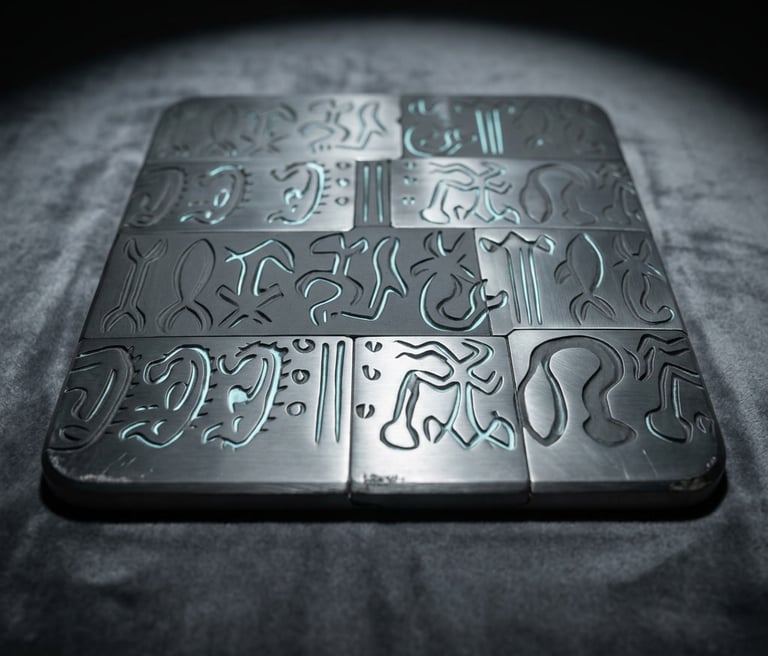
An open, reproducible computational investigation of Rongorongo script, the undeciphered script of Rapa Nui. The project treats the script as a ciphertext-only problem and brings statistical, network analytic, and quantum algorithmic methods to bear. The contribution is methodological.
The critical innovations are diachronic corpus stratification using Ferrara et al.'s 2024 radiocarbon dates as a known key-change boundary, and the application of quantum algorithms of Simon, Bernstein-Vazirani, and QAOA to directly attack the decipherment keyspace on real quantum hardware. No prior computational study has applied either approach.
Hacking Rongo Project
Calls for Collaboration
This project is actively seeking:
Rongorongo scholars willing to evaluate the computational methodology against epigraphic expertise and advise on anchor identification from the ethnographic record.
Museum institutions holding tablets open to radiocarbon dating or high resolution imaging for computational analysis.
Quantum computing researchers interested in undeciphered script complexity and QUBO formulation for annealing hardware.
Computational linguists working on low-resource historical languages and mixed-mode (logo-syllabic) encoding systems.